In this guide
- Airport
- Jiangbei International Airport (CKG); Line 10 serves T3 and T2, Line 3 serves T2.
- Rail
- North, West, East and Shapingba are the main stations. Confirm the station on your ticket.
- Metro
- The clearest way to cross the city. Allow time for deep stations and long interchanges.
- Walking
- Expect stairs, slopes and entrances on different levels. Wear gripped shoes.
- Taxis
- Use the official rank or a ride-hailing app; confirm the drop-off level.
- Cableway
- Xinhua Road ↔ Shangxinjie. A working crossing and a visitor experience; queues vary.
Arriving by air or train
Chongqing Jiangbei International Airport (CKG) is the main air gateway. Two metro lines serve the airport: Line 10 reaches both Terminal 3 and Terminal 2, while Line 3 stops at Terminal 2. Airport shuttle buses, taxis and ride-hailing are also available. Check the airport's official site for the current terminal, airline and ground transport information, especially if you arrive late or have a tight connection.
The city has several mainline railway stations. A 12306 search for “Chongqing” can return trains from more than one station, so confirm the station printed on your ticket before you pay. Use China Railway 12306 or its official app; third-party ticket sites are not official.
| Arrival point | Metro connection | Notes |
|---|---|---|
| Jiangbei Airport T3 | Line 10 | Check the airport's current terminal and shuttle information. |
| Jiangbei Airport T2 | Lines 3 and 10 | Line 3 also serves other parts of the city; check the direction. |
| Chongqing North | Lines 3, 4 and 10; Loop Line at the South Square side | A large station with more than one square and several levels. |
| Chongqing West | Line 5 and Loop Line | A major hub for routes to the southwest and northwest. |
| Chongqing East | Line 6 East Station branch | Check the current service pattern and transfer at Liujiaping. |
| Shapingba | Lines 1, 9 and Loop Line | Integrated with the high-speed railway station and buses. |
| Chongqing Station (Caiyuanba) | Closed for reconstruction | Closed to passengers in 2022; not a current option. Confirm any future status on 12306. |
Metro and urban rail
Urban rail is usually the clearest way to cross the city. Signs and announcements commonly include English, but interchanges can be large. Follow the line number and terminus direction, then check the exit before leaving the paid area. The operator publishes the current network, station and service information at Chongqing Rail Transit.
Fares are distance-based. Buy a single journey at a station machine or use the metro QR code in a payment app where available. Multi-day passes may be available; compare the price with your likely number of rides and check the current terms. Keep a card or some cash as a backup, and do not assume every machine accepts every payment method.
Useful habits
- Check the terminus direction, not just the line number; some lines branch.
- Allow extra time at interchanges such as Jiaochangkou, Xiaoshizi, Lianglukou and Shapingba.
- Peak crowding is common in the morning and late afternoon. Travel outside those windows with luggage if possible.
- Do not eat or drink on the train if local signs prohibit it, and keep doorways clear.
- Last trains vary by line and direction. Check the official site or station notices before a late return.
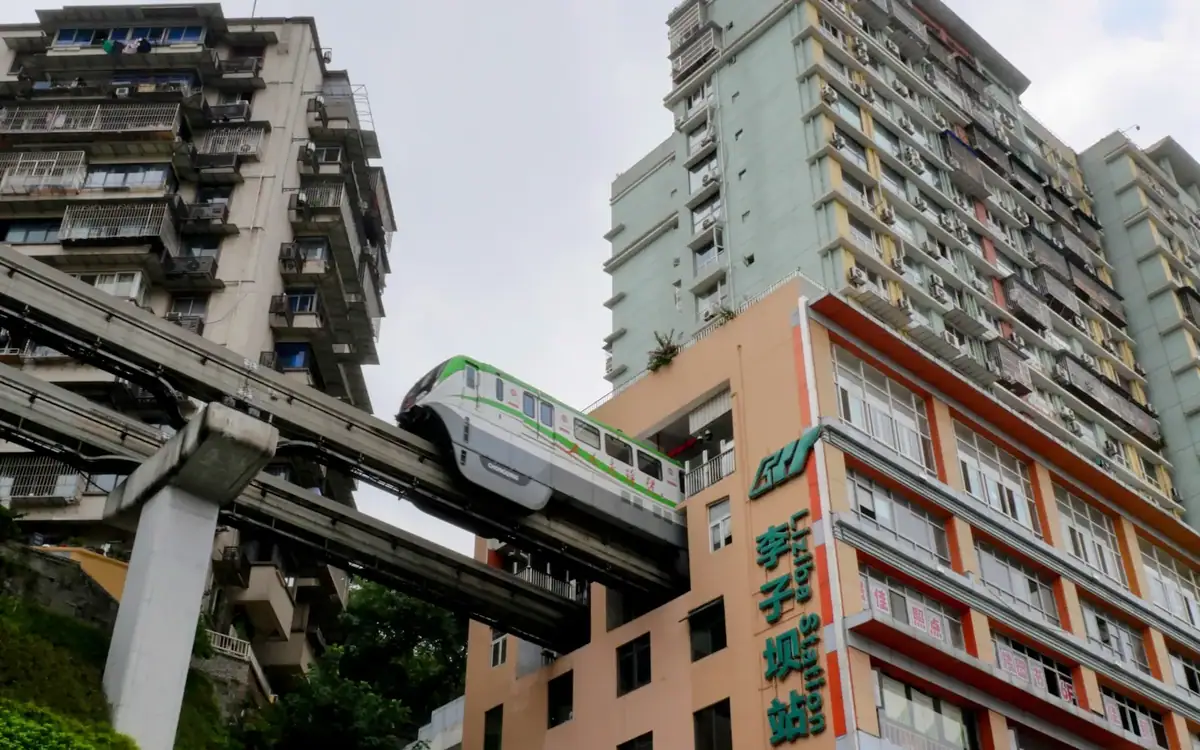
The famous elevated sections are working transport, not rides. Keep platforms and doorways clear, and do not block other passengers for photographs.
Station exits are part of the route
Two exits from one station can deliver you to different levels or opposite sides of a major road. Save the exit number when a guide, venue or accommodation provides one. If a route looks unexpectedly steep, pause and check whether a lift, escalator, indoor passage or another exit offers a better connection.
Useful station anchors
- Xiaoshizi (Lines 1 and 6) — a practical station for Jiefangbei and the Hongyadong side of the peninsula. Follow signs carefully; the exits serve different streets and levels.
- Jiaochangkou (Lines 1 and 2) — useful for Jiefangbei, Shibati and the older lanes. It is a large interchange.
- Linjiangmen (Line 2) — a smaller station on the Jialing side, useful for the riverside and parts of Jiefangbei.
- Liziba (Line 2) — the train-through-building view. Use the designated viewing area and keep the platform clear.
- Shangxinjie (Line 6 and Loop Line) — useful for the south bank, Longmenhao and the cableway's southern station.
Walking in a vertical city
Maps show horizontal distance more reliably than effort. Stairs, elevated plazas and buildings with entrances on several street levels are normal parts of central Chongqing. A route that looks short may include a climb, an underpass or a shopping mall that connects two streets at different heights.
Plan one main area per half-day and allow a margin for wrong-level turns. Carry water in warm weather, wear shoes with grip and take a rail stop or taxi when energy matters more than distance. After rain, stone steps can be slippery.
- Use landmarks as well as street names.
- Check the actual station exit and venue entrance, not only the neighborhood.
- Prefer downhill routes when you have a choice; climbing is harder than the map suggests.
- Keep to pavements and pedestrian routes; do not cut across busy roads for a shortcut.
- Ask staff at stations and museums for step-free routes if you need them.
Taxis and ride services
A car can help with luggage or awkward cross-slope routes, but pickup points may be on a different level from where you are standing. Show the destination in Chinese and confirm the pin before departure. At airports and railway stations, use the official taxi rank rather than an offer from someone approaching you.
Ride-hailing apps are widely used. The app's pickup pin may be at a mall entrance, a hotel lobby or a road level that is not obvious; message the driver with a landmark if possible. Road traffic can slow river crossings at busy periods, so allow extra time for a fixed appointment.
- Keep the Chinese address and a landmark ready.
- Confirm the drop-off level, especially at large buildings and stations.
- Use the meter in a licensed taxi; avoid drivers who refuse it.
- Keep your belongings with you and check the seat before leaving.
The Yangtze River Cableway
The Yangtze River Cableway connects Xinhua Road in Yuzhong with Shangxinjie in Nan'an. It is a working crossing as well as a visitor experience, and the views over the river and the peninsula are the reason many people ride it. Queues can be long at popular times; check the operator's official site for current service and ticketing information.
The cableway is not essential for getting around. The metro to Shangxinjie is a practical alternative, especially in poor weather or when the queue is long. If you ride it, keep the cabin and station areas clear for other passengers and follow staff instructions.
Three rules that make the day easier
- Check the exit before you surface. The right exit can save a steep detour or a difficult road crossing.
- Allow for levels. A ground-floor entrance on one street may meet an upper floor on the next.
- Keep the Chinese address. A map pin is useful; a Chinese address and landmark are more useful when you need to ask for help.
Emergency numbers: 110 police, 120 ambulance, 119 fire. For non-emergency help, ask staff at your hotel, a station information desk or a major visitor site.